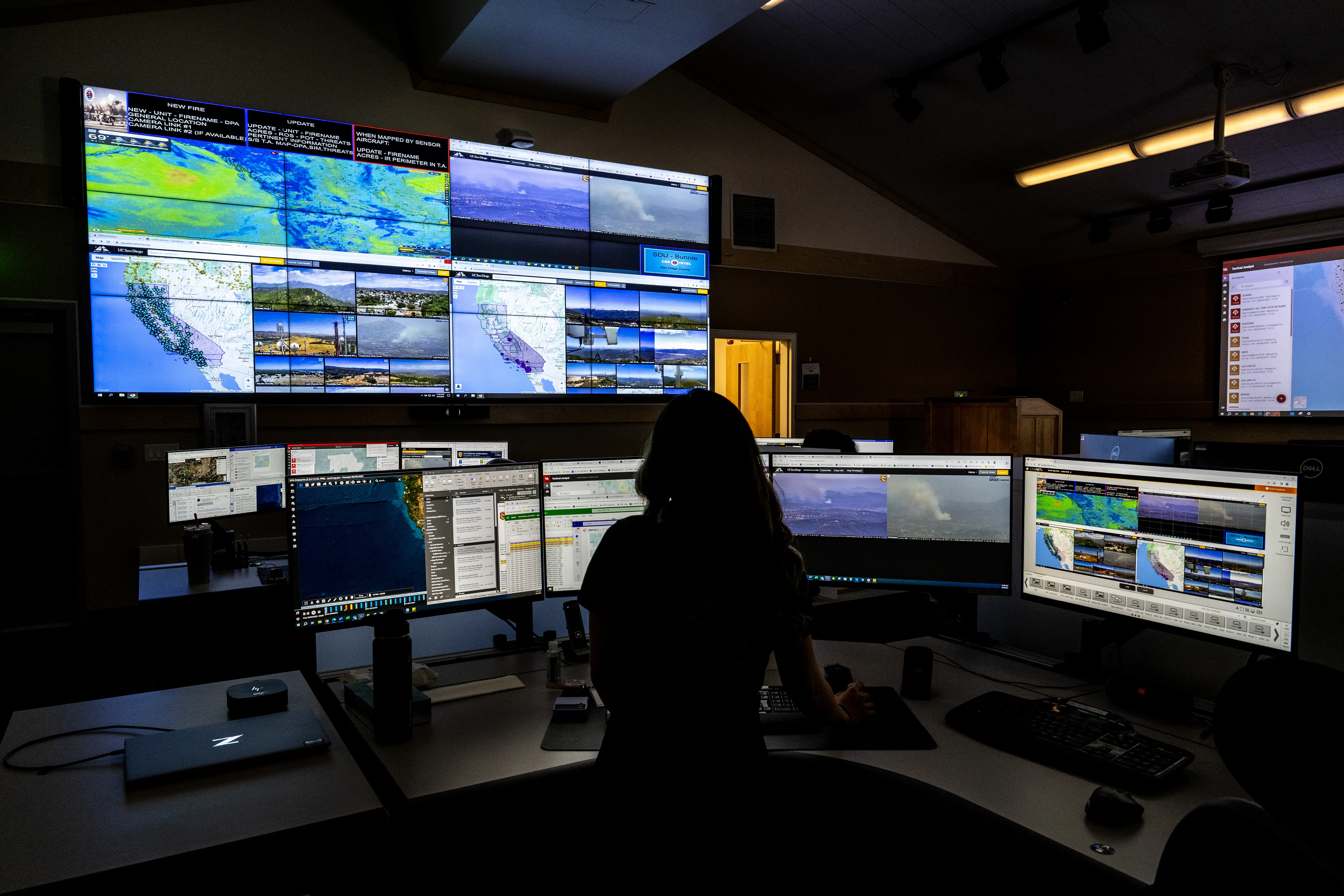
A Cal Fire worker in Moreno Valley, California in 2023. Photo: Gina Ferazzi/Los Angeles Times via Getty Images
AI is already helping detect and monitor wildfires. Now, researchers are exploring how it could help fire officials decide where to deploy crews across multiple fires.
Why it matters: Studies show climate change is contributing to longer, more intense wildfire seasons , forcing officials to make high-stakes decisions about how to prioritize limited resources. AI could help them process information to make those decisions faster.
State of play: Jason Fallon, the U.S. Wildland Fire Service's division chief for wildland fire intelligence, told Axios that AI is ingrained in many areas of wildfire management nationally, including monitoring, detection, information dissemination and data transfer.
Zoom in: Léonard Boussioux, an information systems professor at the University of Washington Foster School of Business, is part of a team researching how machine learning and optimization could assist fire officials in deciding where to send crews when multiple wildfires are burning.
By the numbers: Last year, 77,850 wildfires were recorded across the U.S. — "noticeably higher than the five- and 10-year averages," according to the National Interagency Coordination Center.
What they're saying: "What's hard to do is to predict which fire is going to blow up," Boussioux told Axios.
What we're watching: Fallon said that research like Boussioux's has potential to aid wildfire decision-making, but "I don't think we know yet to what degree."
Reality check: AI's role is to augment firefighters, decision-makers and analysts — not replace them, Fallon said. Fire officials remain "in control of directing the strategy and action," he said.
Between the lines: AI won't solve the problem of massive, destructive wildfires, Matt Weiner, CEO of Megafire Action, a nonprofit focused on reducing catastrophic wildfire risk, told Axios.
What's next: Researchers are developing more sophisticated tools for modeling complicated wildfire decisions, but their usefulness will depend on the quality and organization of the underlying data.
Read the original article — Opens the publisher’s original page